Brachial plexus birth injuries, explained
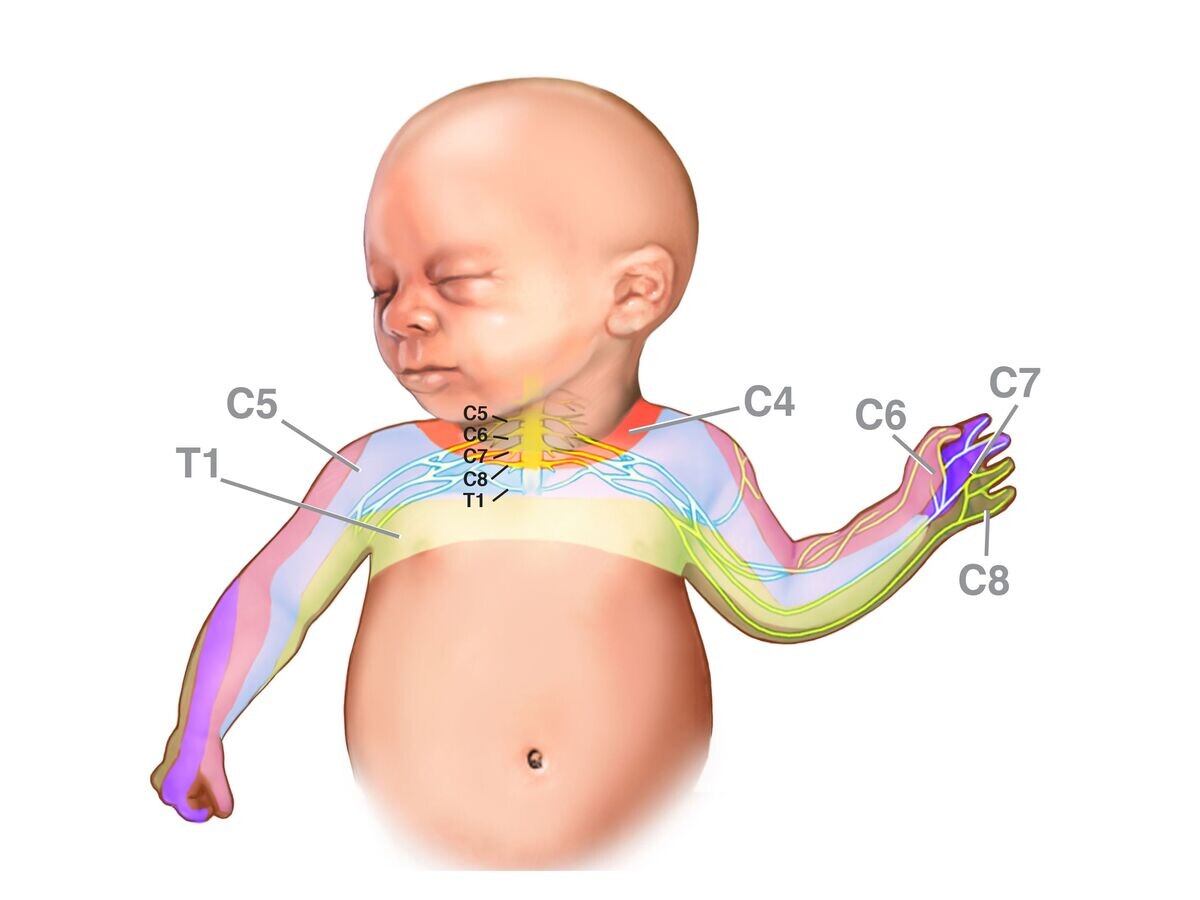
The brachial plexus is the network of nerves that carries every signal between the spinal cord and the arm. Its fibers leave the spinal cord at five levels (C5, C6, C7, C8, and T1) and weave together in the neck and shoulder before branching into the nerves that control the shoulder, elbow, wrist, hand, and fingers. When those nerves are injured during delivery, the signals stop arriving, and a newborn's arm hangs limp, moves weakly, or doesn't move at all.
How the injury happens
The most common mechanism is traction during a difficult delivery. When a baby's shoulder lodges behind the mother's pubic bone, a complication called shoulder dystocia, the head is out but the body cannot follow. If the head is then pulled sideways, away from the stuck shoulder, the angle between neck and shoulder widens and the brachial plexus stretches. Nerves tolerate only so much stretch. Beyond that, they are injured in one of three escalating ways: neurapraxia, a stretch that disrupts signaling but leaves the nerve intact; rupture, a tear of the nerve itself; and avulsion, the tearing of the nerve root from the spinal cord. Avulsion is the most severe form, and it cannot heal on its own.
Which nerves are damaged determines what the family sees. Injury to the upper roots (C5–C6, sometimes C7) produces Erb's palsy, the most common pattern. Injury to the lower roots (C8–T1) produces Klumpke's palsy. Injury across all five levels produces a global palsy: a flail, insensate arm.
What recovery looks like, and what it means when recovery stops
Many newborn brachial plexus palsies are mild stretch injuries, and many of those recover substantially in the first months of life. That fact matters in both directions. It is genuinely good news for most families. And it means that an arm that is still weak, still limited, or still asymmetric as the months pass is telling you something: the injury was more than a mild stretch. Persistent deficits, such as trouble raising the arm, an arm held rotated inward, a hand that doesn't grip, or one arm growing smaller than the other, are the signature of rupture or avulsion, injuries that may require nerve surgery and often leave permanent limitations.
The legal dimension, briefly
Shoulder dystocia is a well-recognized delivery complication with trained-for maneuvers, and the medicine of how these injuries occur is well described. Whether a particular child's injury resulted from a failure to meet the standard of care is a records question. The delivery note, the fetal monitoring strips, and the documented sequence of maneuvers hold the answer, and finding it is what a malpractice investigation is for. Two Florida-specific points families should know early: a brachial plexus injury usually falls outside Florida's NICA program, so the civil claim is typically preserved; and Florida law protects a child's claim until the eighth birthday, though other clocks can run sooner. Both analyses belong in an attorney's hands promptly: records and memories do not improve with age.
Get answers about your child's injury
Free, confidential review by a Florida medical malpractice attorney. No fee unless we recover for you.