Global palsy and avulsion: the most severe injuries
In a global (total) brachial plexus palsy, all five nerve roots, C5 through T1, are injured. The arm is flail: it does not move at the shoulder, elbow, wrist, or hand, and sensation is reduced or absent. This is the least common pattern of brachial plexus birth injury and by a wide margin the most serious.
What avulsion means
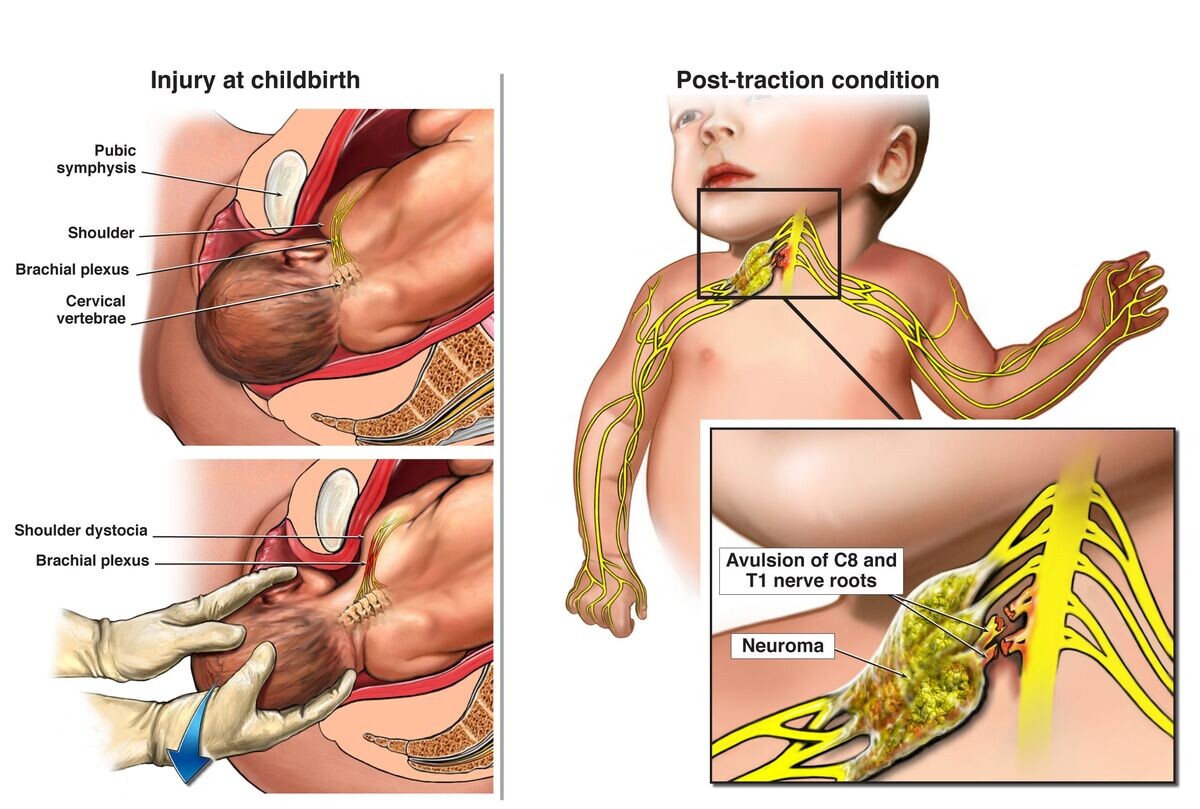
Nerve injuries exist on a spectrum. A stretched nerve can recover. A ruptured nerve, torn somewhere along its length, can sometimes be repaired or grafted. An avulsed nerve root has been torn out of the spinal cord itself, and that connection cannot be re-established: no therapy regrows it, and surgical reconstruction works around it, borrowing nerves from elsewhere rather than repairing what was lost. Where an injured nerve attempts to heal across a gap it cannot bridge, a disorganized ball of scar and nerve fibers called a neuroma can form: regrowth that goes nowhere.
Clinical signs that point toward avulsion include a completely flail arm from birth, Horner's syndrome (discussed on the Klumpke's palsy page), and characteristic findings on MRI. This is why imaging matters so much in severe cases, and why my case evaluation asks whether an MRI has been done. Imaging converts an argument about severity into a documented fact.
What treatment can and cannot do
Children with global palsy are the clearest candidates for early surgical referral. Nerve grafting and nerve transfers, performed in the first year, can restore meaningful function, with elbow flexion and shoulder stability the usual priorities. But the honest frame is that surgery in these cases is about recovering some function, not restoring a normal arm. These children face a childhood of procedures, therapy, and adaptation, and an adulthood with real limitations. The treatment and prognosis page covers the pathway in more detail.
The legal stakes are at their highest here
Severity changes everything about the legal case: the lifetime cost of care, the lost earning capacity, the human damages a jury weighs. It also deepens the required investigation. Severe traction injuries demand a close look at how the delivery was managed, from recognition of risk factors through the response to the dystocia itself. One Florida nuance belongs in an attorney's hands immediately: because avulsion involves the junction with the spinal cord, and because the most catastrophic deliveries can involve additional injuries, the NICA analysis in severe cases is genuinely fact-specific and should be run early, not assumed in either direction.
Get answers about your child's injury
Free, confidential review by a Florida medical malpractice attorney. No fee unless we recover for you.